20 January 2015

Christmas road-trip: A boat ride on Lake Victoria and fun at Dunga Beach


Hannah and I spent three and a half days at Kisumu, much of which was on or around Lake Victoria. I was happy to see there was much less Water Hyacinth on the lake than previous times I was there. It had become quite a nuisance for many years, blocking fishing and commuting boats.

Lake Victoria is the largest tropical lake in the world. Measured by surface area, it's the second largest body of fresh water, second only to Lake Superior in the United States. Beside Kenya (at only 6%), its shoreline is also shared by Uganda (45%) and Tanzania (49%). It's one of the sources of the River Nile.

The photo above and the following five are from a very enjoyable two-hour boat ride we started at sunrise.

Early in the morning, the lake was as smooth as glass.                                                                                                         Overnight fishermen are resting in their boat until Dunga Beach opens for business at 9am.

We saw many small boats with fishermen.

Pied Kingfishers are known for hovering over lakes before diving for fish.

Hammerkops build huge nests up to four feet wide and with up to 10,000 sticks.

African Fish Eagle - Females can weigh up to 8 pounds, males 5.5 pounds.

After our boat ride, we spent several hours at Dunga Beach.

The overnight fishermen come in at 9am with their catch of Omena and Tilapia. Ready to greet them is a throng of female fishmongers, ready to bargain hard to fill their plastic basins full of fish. Once they've made their purchase, they disperse to various neighborhoods or fish markets to sell them - thus earning their daily bread. It was quite a fascinating scene to watch! Later in the afternoon, the day fishermen come in with their catch of Nile Perch and a different group of women come to buy from them.


One of the many fishmongers

As the fishermen approach the shore, they drop their sails and row the last bit.

Yellow-Billed Storks can reach over 40 inches in height.

We had lunch at one of the restaurants at Dunga Beach. This is the comical remains of Hannah's Nile Perch.


All photos were taken by my friend, Hannah

19 January 2015

Christmas road-trip: Kerio View Hotel and paragliders


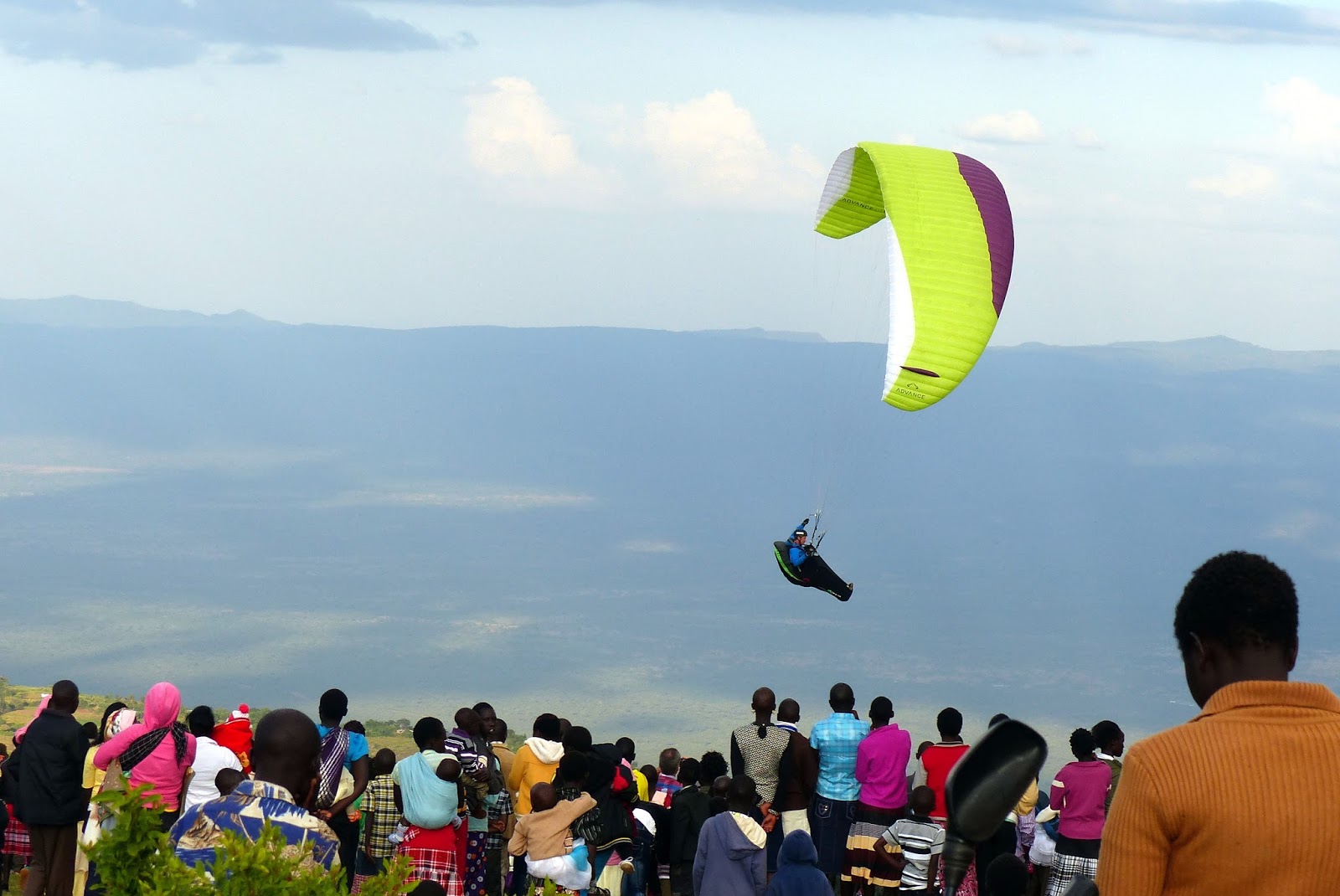
Hannah and I enjoyed a wonderful 10-day road trip over Christmas. It was a mix of ministry (as seen in the previous two posts) and pleasure. Christmas Day found us at Kerio View Hotel just outside of Iten, Kenya (near Eldoret). It was a first-time visit for both of us and we loved it! The view is absolutely stunning and the food was delicious.


Coincidentally there were about a dozen German para-gliders enjoying their sport.

Baglefect Weaver

Such an incredible view of Kerio Valley, part of the Great Rift Valley

Village several hundred feet below us

Iten is the home and training ground of many of the world's top marathoners.


All photos were taken by my friend, Hannah.

15 January 2015

Christmas road-trip: Hiking at Mount Elgon

Endebess Bluff (8,400 feet in elevation)

“We are now in the mountains and they are in us, kindling enthusiasm, 
making every nerve quiver, filling every pore and cell of us.”
~ John Muir


“Climb the mountains and get their good tidings. 
Nature's peace will flow into you as sunshine flows into trees. 
The winds will blow their own freshness into you, and the storms their energy, 
while cares will drop away from you like the leaves of Autumn.”
~ John Muir

We had a lovely lunch break on Elephant Platform, with such a stunning view. Uncle John was our guide for the day.

“Thousands of tired, nerve-shaken, over-civilized people 
are beginning to find out that going to the mountains is going home; 
that wildness is a necessity”
~ John Muir

Out in the distance is Uganda

Mount Elgon is an extinct volcano, west of Kitale and straddling the border of Uganda and Kenya, with a high point of 14,000 feet. It's the oldest and largest solitary volcano in East Africa, covering an area of 1,350 square miles. We spent most of a day hiking around certain areas. Getting up to Endebess Bluff was quite steep, but a good challenge.

Photographing a waterfall as I stand inside Kitum Cave

We saw a LOT of recent elephant footprints in both dust and mud (photo on left) and MANY piles of dung... but we didn't see elephants. I read that they mostly come at night. The skull is from a young elephant that apparently fell and didn't make it out.

Kitum Cave is 200 feet wide and 650 feet deep. It contains salt deposits and it is frequented by elephants, buffalo, bushbuck, and hyena. The elephants gouge the walls with their tusks, which exposes the salt. The smaller animals eat the pieces the elephants leave behind.

Colorful pond inside the cave

Beautiful flower, maybe a thistle?

Large troop of baboons

Waterbuck, a beautiful large antelope

14 January 2015

Christmas road-trip: Laban's party to celebrate being circumcised

Laban is the firstborn son of my friends, Nathan and Alice. For the 8.5 years I had my mud hut, they lived just a short distance down the hill. During those years, they had me over for dinner numerous times - always for chicken and ugali. Nathan also used to take care of my house whenever I was away.

Like many other Bukusu boys his age, Laban was circumcised a few months ago. It's typically done among this people group in August of every even-numbered year.

The following December (during the long school vacation), a celebration party is usually held. Friends and family bring gifts, and also bless the boys and pray for them.

Hannah and I were privileged to be in attendance at this special occasion in a village called Fafaral.


The event was held at Nathan and Alice's home, where they constructed a covering for the attendees.

The Bukusu are one of the Luhya sub-tribes; the Luhya are the third largest tribe in Kenya (after Kikuyu and Luo). They mostly live in the western part of Kenya. The Bukusu practice male circumcision, a traditional rite of passage for boys moving from childhood to adulthood. In their language, it's called khukhwingila, which whens means 'to enter'.

Traditionally it has been done outdoors, as a lengthy overnight event. The boys were circumcised in age-groups and the practice had a lot of traditional rituals associated with it. However, in modern times, more families are taking their boys to proper medical clinics for the procedure and the traditional beliefs are being replaced with a Christian viewpoint.


The party was held outside under the canopy. Those that didn't get seats, found a spot on the ground. Some folks hadn't seen each other for a long time, so there was a lot of joy. There was also lots of singing praise and worship songs. The music and the speeches were carried throughout the neighborhood with loud speakers.

There's always a special time for giving gifts, accompanied by lots of dancing and celebration. I gave Laban a new Bible; he was also given small cash gifts, a blanket, a large bunch of bananas, and this goat.

After the ceremony, everyone enjoyed a nice lunch and later - chai and mandazi (fried bread).

Laban's mom, Alice (middle foreground), and others enjoyed dancing and praising the Lord.

A bit part of any gathering in Kenya is speeches or 'saying a few words'. This is a small sample of those that greeted the crowd and addressed some comments to Laban: a 'mzee' (older gentleman), myself, Laban's young friend, a pastor friend of Nathan's, and Bishop (Nathan's older brother and Laban's uncle). 


It rained during the last part of the ceremony, so some people squeezed inside the house for lunch.

Others sat under the canopy.

Some found a spot wherever they could manage.

Proud parents and excellent host and hostess, Nathan and Alice

Jonas (Bishop and Nathan's oldest sister) who I had not seen for several years, and Laban

Just some of the many friends that came for the special occasion. I've known Pastor Job (center) for many years.


A few fun shots of the many children that attended
. . .

All of the photos were taken by my friend, Hannah, but I filmed the video clips.

13 January 2015

Christmas road-trip: Visits with Mary's and Agnes' families

Edgar with Maggie and Damaris (two neices), and his son, Seth

A beautiful young girl, one of Mary's relatives
 
Seth with his mom, Eliza (Mama Manu)

Seems Robert and I ran out of things to talk about, while relaxing on his mom's veranda :)

Adu cooks ugali for lunch, to go with our duck

Duane built this detailed two-story house out of mud

He used modeling clay to make this person sitting on a couch eating food

Duane and Zach (on the right) with two of their cousins from Kocholiya


Adu and Tony show off their strength, by lifting their homemade set of barbells


All photos except the last two were taken by my friend, Hannah.

30 December 2014

What I learned living cross-culturally as a Christian, written by Cindy Brandt


One of my favorite quotes regarding living cross-culturally is this one by Duane Elmer:

"Among the hardest tasks in life is to divest (rid or strip) ourselves of the culture we wear so comfortably."


I think the following piece, written by Cindy Brandt, does a good job examining this struggle:


What I learned living cross culturally as a Christian
We all wear a set of spectacles. Everyone does. Those lenses dictate the way we view life. They determine the habits we make, what to eat, when to sleep, when to marry, and how to work. They assign value to our lives, determining what is meaningful: family, faith, honor, love.

What I learned living cross culturally as a Christian is that you can see Jesus wearing different spectacles. You do not have to abandon your spectacles, or switch it out for a new one in order to find Jesus. You do not have to forsake the cultural values you were assigned at birth, taught by your parents, passed down by your ancestors, in order to know Jesus. No, you find Jesus by looking through them.

What I learned living cross culturally as a Christian is that some people have mistaken the Good News to be changing out the spectacles for new ones. We have reduced the Gospel to be an exchange of values and habits. What I have seen in both cultures I reside in, is that there are good values and bad values in both; we are differently good and differently bad. We are quite equally flawed, not one culture can claim superiority to teach the other much. As long as we believe we are the Bearer of Right Values, we will be pronouncing ill-informed judgment on other cultures because we have not yet learned to see God through their spectacles.

What I learned living cross culturally as a Christian is there is more than one right way to be Christian. When you see Jesus differently, your walk with Jesus is going to look differently. When people with different spectacles worship Jesus in the same way, it is likely because the dominant cultural narrative have subsumed the minority, often in the name of unity. They say that God is the same here, there, and everywhere, therefore if you follow God, you will look like me. Uniformity is a passive form of aggression. Homogeneity is coercing everyone to wear one pair of cultural lenses. It is leaving some people stripped of their core values, robbing them of dignity, leaving them without sight to see their way forward. It is perpetuating violence in the name of a nonviolent Jesus. The Good News is not that there are new spectacles we get to force upon other people’s faces. Jesus came wearing old spectacles, practicing Jewish laws, performing Jewish rituals.

What I learned living cross culturally as a Christian is that so much strife, across races, cultures, and nations, happen as a result of people being unaware of their spectacles, believing their worldview is the only right way to live. They begin to see others who live differently as evil or secular. That their way of living is uncivilized, less enlightened, sub-human. They refuse to believe that others also see God, that their lenses are just as clear, their view just as bright. That God reveals Jesus to everyone regardless of what culture they were raised in, no matter what color their skin.

What I learned living cross culturally as a Christian is that the Good News is the possibility for every tribe and nation to to participate in the life-giving, humanity affirming way of Jesus. When he taught us to love our enemies, he is showing us the way to honor a different way of doing life, to rest assure us all that every person is made in God’s image but situated to see God differently.

What I learned living cross culturally as a Christian is that the Gospel makes room for everyone, those who wear this set of lenses or that. It is Good News, indeed, that not any of us possess the singular image of God, that we only see a partial view, so that we spend our lives inviting more people to our table, to sit, eat, and tell us what they see.


Cindy was raised cross culturally, married cross-culturally, worked cross-culturally, and is raising her kids cross-culturally. She is grateful to be privileged with a unique vantage point - like she has been given two sets of spectacles in a world where most people wear only one.

Cindy writes at cindywords.com