30 April 2013

Mashujaa Day Picnic: celebrating 11 years in Kenya! October 2012


In 2011, I hosted a picnic at Uhuru Park in downtown Nairobi to celebrate being in Kenya for 10 years. Everyone had so much fun that we did it again last year to celebrate 11 years!

Again, we had it on Mashujaa Day - a national holiday honoring Kenya's heroes. This time, I encouraged everyone to dress in Kenya's flag colors.


We enjoyed the paddle boats on the pond.


We played some really silly games.

LOTS of laughs!

It was a two-thumbs-up day!

Many of my friends met other friends of mine that they hadn't known before.

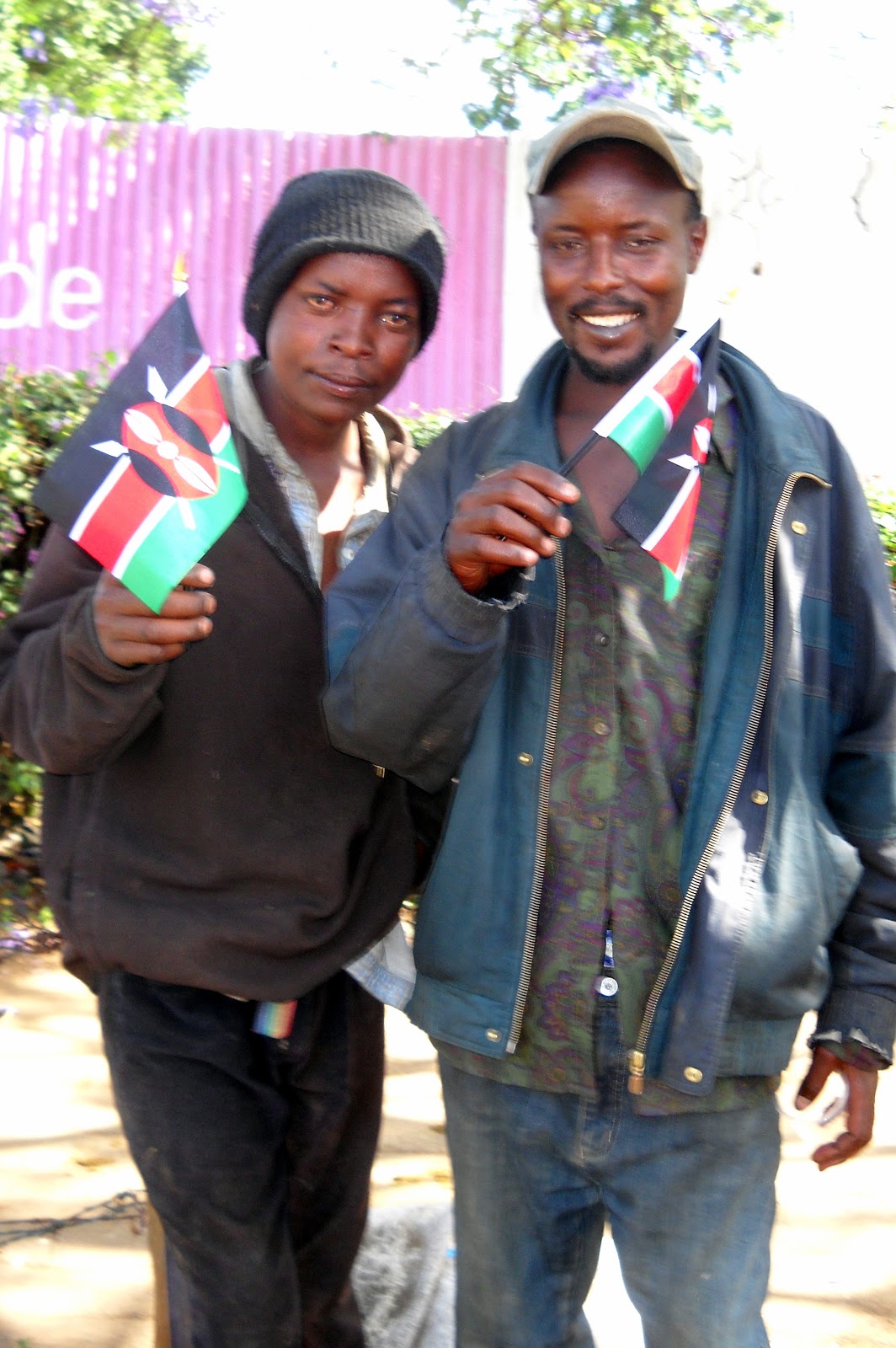
These homeless guys ate with us.

This homeless kid REALLY enjoyed flying kites with Jeremy!

.

10 April 2013

Uhuru Kenyatta, son of Kenya's first president, is sworn into office


The following is an excerpt from Uhuru's acceptance speech:

"Fellow Kenyans, today work begins.

The time has come to ask, not what community we come from, but rather what dreams we share. The time has come to ask, not what political party we belong to, but rather what partnerships we can build. The time has come to ask, not who we voted for, but what future we are devoted to.

Fellow Kenyans, we must move forward together. Let us remember that although we may not be bound together by ethnicity, or cultural practices, or religious conviction – our kinship rests solidly upon the fact that we have all been adopted by Kenya’s borders. We are all children of this nation. We are all bound to one constitution which calls us to rise above our individual ideologies and march to our national anthem.

That anthem reminds us of the fundamental principles upon which our prosperity must be built. It calls us to reflect on the power of peace; to recall the supreme value of freedom; to believe, once more, in the beauty of service and brotherhood; to aspire each day, to the dignity that results from hard work, and to contend for the hope that justice brings.

Brothers and sisters, fellow Kenyans – let us move forward, together, in the spirit of our anthem and in the spirit of our constitution, being confident that if we turn neither to the left nor to the right of our national values, we, as a people, will see the promised land of prosperity that our forebears set out for.

God bless you, God bless the Republic of Kenya, and God bless Africa."


Uhuru Kenyatta is the son of Jomo Kenyatta, Kenya's first president, who ruled from 1964–1978. His name, Uhuru, is Swahili for "freedom". He was born in 1961, just two years before Kenya gained her freedom from British colonialism in 1963. Uhuru is Kenya's fourth president and he is the youngest, at 51, to take office.


Jomo Kenyatta, Kenya's first president

Young Uhuru with his father, President Jomo Kenyatta


I watched the swearing-in ceremony on live-stream, while in Singapore.
My grand-daughter, Mia, peppered me with great questions during the event.


08 April 2013

I Have Big Dreams for My Daughter


by Josaya Wasonga, writing for the Daily Nation


I have a dream…

That one day my daughter will live in a country that will not judge her by surname or mother tongue, but by her contribution to the national good.

My daughter’s surname is what I gave her. Which does not define her. Her mother tongue or, specifically, tribe, is what Maya Angelou may call “the accident of birth”.

It is my daughter's input, not her ethnicity, which will say if she is just what the progress doctor ordered… or a doggone pain in Kenya’s neck.

I have a dream…

That I will live to see my daughter endorsing political candidates from other communities and not be slapped with the traitor moniker. And vice versa.

That one day if and when my daughter decides to run for President of the Republic of Kenya, her aspiration will not be thwarted because of creed, tribe, or gender.

I believe that leaders are both born and made. Born and then, like rough diamonds, sharpened around dinner tables, behind classroom desks, and in front of mentors and Goliaths.

Folks, I have a dream…

That my daughter will dream impossible dreams, live the Kenyan Dream, and not feel as if she cannot make it because of her social status.

I will let my child be - whether hers is to be a scholar or seamstress - and not shove my dead dreams down her throat.

All long journeys start with one step: a dream. My byline is a testimony that dreams come true. I refused to listen to negativity, even when friends (and ex-flames) said my writing dream was dead in the water.

I have a dream…

That the safety of my daughter will be guaranteed and I will not worry myself sick the way I sometimes do. Especially when there is a news item on telly that a child has been abused.

If we cannot guarantee the safety of tomorrow’s leaders, can we guarantee the safety of tomorrow’s nation? And how will our children pursue their dreams and build the nation while they are shadowed by demons? Our children’s safety is not just Caesar’s headache, but our collective responsibility. If one child is abused and the pervert is still walking free, then, trust this rape survivor, all our children are mere sitting ducks.

“We are tied together in the single garment of destiny, caught in an inescapable network of mutuality. And whatever affects one directly affects all indirectly. For some strange reason, I can never be what I ought to be until you are what you ought to be. And you can never be what you ought to be until I am what I ought to be. This is the way God’s universe is made; this is the way it is structured.”
- Martin Luther King Jr.

04 April 2013

Kenya's Supreme Court Makes Decision on Election Petition

Raila announces he will file a petition with the Supreme Court, disputing election results

“Kenya’s Democracy is on Trial” were the words of incumbent Prime Minister Raila Odinga who lost the March 4th presidential election to Uhuru Kenyatta. Raila, who came in second, filed a petition at the Supreme Court on March 16, to oppose the results of the General Elections. He claimed they were flawed to favor Kenyatta and give him a first round win.

The Prime Minister criticized the Independent Electoral and Boundaries Commission, charged to conduct elections, saying that the commission presided over a “sham” process that unfairly denied him the chance to become the fourth president of the Republic Of Kenya.


Kenya's Supreme Court was established in 2010.

Excerpt of the Supreme Court's decision as read by Chief Justice, Willie Mutunga (third from left), on March 30):
1. After extensive deliberations, we are happy to announce the Supreme Court has reached a unanimous decision on all the four issues that fell for determination in presidential election.

2. The following is the unanimous decision of the court:

(i) As to whether the presidential election held on March 4th 2013, was conducted in a free, fair, transparent and credible manner, in compliance with the provisions of the Constitution and all relevant provisions of the law; it is the decision of the court that the said elections were indeed conducted in compliance with the Constitution and the law.

(ii) As to whether the 3rd and 4th Respondents (Uhuru and Ruto) were validly elected and declared as President-elect and Deputy President-elect of the Republic of Kenya respectively, by the Second Respondent (Issack Hassan) in the presidential elections held on the 4th March 2013; it is the decision of the court that the 3rd and 4th respondents were validly elected.


Raila Odinga, Prime Minister of Kenya and runner-up to President-elect, Uhuru Kenyatta

Excerpt from Raila's speech after the Supreme Court's decision:
Our decision to file a petition in the Supreme Court to challenge the validity of the election was a testament of my faith in the independence of our Judiciary. We did so for the sake of our democracy and for the sake of all Kenyans who wanted to exercise their constitutional right to elect their leaders through a free and fair election.

Although we may not agree with some of [the court's] findings, and despite all the anomalies we have pointed out, our belief in constitutionalism remains supreme. Casting doubt on the judgment of the court could lead to higher political and economic uncertainty, and make it more difficult for our country to move forward. We must soldier on in our resolve to reform our politics and institutions. Respect for the supremacy of the Constitution in resolving disputes between fellow citizens is the surest foundation of our democratic society.

My belief in constitutionalism remains supreme. We as a country must move forward in our resolve to reform our politics and institutions. Respect for the supremacy of the constitution in resolving disputes is the surest foundation of our democratic society. This court process is yet another milestone on our road towards democracy for which we have fought for so long. Truth, justice, and the faithful implementation of the constitution is our best guarantee to peace and security.

It is my hope that the incoming government will have fidelity to our constitution and implement it to the letter for the betterment of Kenya. I wish the President-elect, Uhuru Kenyatta, and his team well.

I thank the Kenyans who supported us in our petition. I assure you, I will continue to work for and with you for our country Kenya. The future of Kenya is bright. Let us not allow the elections to divide us. Let us re-unite as a nation. I call on all Kenyans to remember the sacred words of our national anthem: Justice be our shield and defender. God bless you and God bless Kenya.


Ahmed Issack Hassan, Chairman of Kenya's Electoral Commission

Excerpts from a statement issued by Issack Hassan, after the Supreme Court's ruling:
The court has demonstrated a high level of professionalism by listening impartially to the litigants. The journey toward this election was very involving: starting from the voter registration, inspection of the register, nominations, and finally the election which was conducted on March 4th.

We also acknowledge the respondents for equally embracing the unifying role of judicial settlement of disputes. There are no winners and losers in this case and Kenyans should remain united and peaceful. This case is a classic example of how far Kenya has matured democratically.


President-elect, Uhuru Kenyatta

Excerpts from Uhuru Kenyatta's speech after the Supreme Court ruling:
I want to assure all Kenyans, including those who did not vote for the Jubilee Coalition, and indeed even those who challenged the validity of my election, that my Government will work with, and serve all Kenyans without any discrimination whatsoever.

Personally, I sincerely thank my brother Hon. Raila Odinga for wishing us well and reach out to him and our other worthy competitors to join us so that we can work together in the interest of the well-being of our people. Let us rise above the differences of the electoral period and continue co-existing peacefully as brothers and sisters. Above all, let us all continue to pray for peace in our country.


Gabriel Gatehouse, BBC correspondent

Analysis from Gabriel Gatehouse, BBC News:
"No Raila, no peace," one man shouted in Kibera, Nairobi's largest slum and Mr Odinga's biggest stronghold in the capital. The three-time presidential hopeful faced a choice today. His supporters were waiting for him to speak. When he took to the microphone, his words seemed designed to calm rather than inflame.

It was a gracious speech, the speech of a man who had put peace before ambition. Some will argue that Raila put peace before the truth. Once the dust settles on this period of uncertainty, there will still be questions about how this election was conducted, and the implications of the failings of the IEBC, the electoral commission, for future polls.

Meanwhile, Uhuru Kenyatta has been receiving the customary international congratulations. In the run-up to the election, some had warned of "consequences" if Kenya elected a president indicted by the International Criminal Court.

That has now become a reality. The key test will be to what extent diplomats, and indeed Mr Kenyatta himself, can mitigate those consequences.


Analysis from Kap Kirwok, writing for The Star:
Beyond the ruling, the whole political contest has thrown up dynamics whose interplay will shape Kenya into the foreseeable future. It is not true that this election has been peaceful. Peace is not just the absence of war or violence. It is freedom from disturbance - a sense of quiet and tranquility.

The ferocious tribal clash waged in social media deny the notion of having had a peaceful election. In that arena, it is war minus the shooting. These cyberspace duels make two things very clear:

  • The distance between digital slash and burn and actual physical combat is not as far as you might think. 
  • Hatreds run deeper than we are willing to admit.

When you look beneath all the sound and fury, the grievance can be reduced to a primitive denominator: tribal competition. One side accuses the other of serial thievery and domination; the accused side responds with a you-can-do-nothing-about-it shrug. There is much huffing and puffing; insults are traded freely.

The country is split along this primitive narrative. The new presidency will need to move courageously and with speed to address this dangerous rift. .


.

03 April 2013

Interesting new leaders for Kenya

Peris Tobiko is a 42-year-old mother of four who made history in March when she became the first Maasai woman elected to Kenya’s Parliament. Despite significant challenges, Tobiko defeated four men in the race to represent the Kajiado East constituency in Kenya’s Rift Valley province. During Tobiko’s campaign, Maasai elders publicly declared that they would curse anyone who voted for her, she says. Her opponents also urged community members not to vote for her, saying it defied their culture to elect women as leaders.

She says her win in the March 4 elections marks a milestone for her and other women in the Maasai community, a nomadic herding people. She says her community does not value the education of girls, and families marry off their daughters as soon as they reach puberty. Her father wanted to educate all his children but occasionally succumbed to community pressure.

Twice, her father attempted to pull Tobiko out of school and marry her to older men, she says. Both times, she avoided the marriage. “My elder sisters were pulled out of school and married off, but I was lucky that teachers intervened in my case,” Tobiko says. “I was performing well, so teachers wanted to keep me in school.”

“I believe if women are empowered economically, men will be the ones calling for affirmative action.”


36-year old Linet Kemunto Nyakeriga (pictured) was born blind. In Kenya's recent election, she was nominated to represent people with disabilities in Kenya's inaugural 67-member Senate. “I have committed to myself to use this new opportunity to articulate issues of people with disabilities in the Senate."

Additionally, Sammy Leshore (who is confined to a wheelchair) and Harun Kipchumba (who is physically handicapped) were both nominated as Senators representing people with disabilities.


This teenager made history in Kenya by winning a county assembly seat. Nineteen-year-old Kibiwott Munge, won in Baringo, becoming the youngest Kenyan to clinch a political seat in an election.

“This is a victory for young people and a clear indication they have what it takes to lead this country,” said Mr Munge in his acceptance speech.


Silvance Osele Onyango, the 26-year old new Member of Parliament, was raised in a remote village. 

"I have been touched by the fact that the youth have always been viewed as leaders of tomorrow, a situation that has hindered their development. I am waiting for Parliament to kick-off so that I introduce bills which will enhance livelihoods of the youth," Osele stated.


There is an unprecedented number of women in the 11th Parliament - most of them young - who have been handed free seats courtesy of the Constitution. After one of the most high-profile campaigns in Kenya's history, 87 of the 416 seats in the House and Senate will be held by women. Previously, just 22 women sat in the old 222-seat Parliament, which did not have a Senate. 

While the ‘two-thirds rule’of the Constitution requires that another 52 women be nominated by political parties before 2015, for MPs, civil society, and UN Women, the next step is to ensure this process is conducted swiftly and fairly.


Senate Speaker Ekwee Ethuro (centre) and nominated Senator Zipporah Kittony
do a jig at a dinner for members of the new House, following their swearing-in.
Close to three quarters of the elected members of the National Assembly are newcomers to Parliament. Out of the 349 members, only 58 members of the Tenth Parliament made it back to the National Assembly in the March 4 election.


Kenya’s Asian community has largely remained apolitical, choosing instead to build clout through business. But a new wind is blowing across the nation, and that wind has brought three Asian MP's. For Kisumu East MP Shakeel Shabir, Embakasi South’s Irshad Sumra and Imenti North’s Abdul Rahim Dawood (pictured), this election was not about familial or cultural numbers, but about ideas, policies, and promises.


Wesley Korir won the Boston Marathon last year and this year was voted in as one of Kenya's new Members of Parliament. He proved that he's not only about running; he can also inspire! If he wins at Boston again next month, he'll be the first MP in the world to win a marathon.


April 20, 2013 Update
Wesley Korir came in fifth in this year's Boston Marathon. When asked about the bomb explosions, by the BBC Newsday program, Korir said, "If this had happened two hours earlier, maybe I would have been among the victims."

He had been celebrating Kenyan Rita Jeptoo's victory in the women's race when he heard about it. "The joy that we had has all been taken away." Ms Jeptoo comes from the Cherangany constituency, for which Mr Korir was elected an MP in last month's election.

Despite the blasts and his new political career, he says he will continue to compete in marathons - even in Boston, if it is held again next year. "My attitude toward marathons will never change but my attitude toward life changes (after such an incident)."

"It makes you ask one question, 'Where is the world going?'"

12 March 2013

With Baby Amani here, Kenya is reborn

Baby boy born while his mom queued to vote in Kenya's election
by Edith Fortunate, DN2, March 11, 2013


The patriotic call to duty was what ran through Elizabeth Mwende’s mind as she braved the early morning cold and long queues to cast her ballot last Monday. She had keenly followed the call to get out and vote over the weeks preceding the elections, and even though she was seven months pregnant, she decided to heed it.

“There was this one advert that stuck in my mind; the one with the tagline ‘Nitakuwepo’” (Swahili for 'I'll be there'), she says. “It tugged at my heart and I decided I will be on the line on Monday to do duty for my country.”

And so, seven months pregnant, Mwende woke up at 3am and headed for the polling station in Muthurwa, Nairobi. After hours standing in the line, she developed premature labor. Mwende looked disturbed, then clutched her stomach and went down on her knees. A crowd gathered around her to see what was happening; then her water broke.


Her baby was born at 6:15am. By then, other women had surrounded her with lesos to protect her from prying eyes. The baby boy, who she named Amani (Swahili for 'peace'), was born at the polling station, and shortly afterwards both baby and mother were rushed to Pumwani Maternity Hospital.

What intrigued many at the polling station, however, was the determination to vote that Mwende displayed. Even after giving birth, she asked the polling clerks whether they would let her cast her ballot, and they obliged before she was driven to the hospital in an election-observer car.

Baby Amani, weighing slightly over two pounds, was immediately put in an incubator because he had breathing problems. A matron at the hospital told DN2 that, because the baby had been born prematurely, he was likely to stay in the hospital for some time.

“We suspect that the breathing problems were caused by the cold the baby was exposed to,” said the matron. “Premature births are best done in warm environments.”

Still groggy from the medication she had been given, Mwende said she was glad it had all come to pass, and that Baby Amani would serve as a constant reminder to her of the lengths to which she went to honor the call to national duty.

“I wanted to part of Kenya’s history in electing the leadership of this nation,” she said, her voice weak from the effects of the ordeal. “I have a strong vision for this country, and being part of history was all I wanted. I did this for Kenya, because I want change for the country.”

This was Mwende’s first time to vote, and she hopes to do it again, and again, and again.

Kenya's amazing display of patriotism

Since 2007, every time you hear the words ‘Kenyans’ and ‘politics’ uttered in the same breath, you might imagine the worst. But then again, every time you see Kenyans acting on politics, you witness the best.

During election day and the ensuing days while waiting for the results, Kenyans proved they have something else - the spirit of hope, resilience, patience, love for their country, and respect for their fellow Kenyans. The only other time the older generation said they witnessed what we went through over the past few days, was during the dawn of independence.


Hail the people of Kenya! by Peter Oduor, DN2 magazine, March 11

The world paused to watch Kenyans troop out to vote on Monday last week, and blogged in awe as the elderly, the youthful, the sickly, and the healthy joined kilometer-long lines to polling stations in a show of regal patriotism never witnessed this side of independence.

If you woke up at 5am on Monday morning to vote, you woke up late. Because, by this time, some of the 33,000-plus polling stations in all the 47 counties had significant queues. Some 14.3 million people registered to vote for this election, and a good number were on their way out. In the villages, cocks crowed to empty homes since, as early as 3am, Kenyans were out plodding their way in the darkness towards their voting centers.

They stayed at the stations, most of which were opened between 6am and 8am, till well past 9pm in some centers, with others going on into the night. In some places, the wind blew cold and misty. In others, it blew hot and dusty. In the end, the day proved long for all.

Civic duty
It may have been a democratic right. It may have been a civic duty. It may have been the courage to view themselves as employers giving a select few the authority, space, and power to represent them and articulate their interests at a higher level. It may have been the knowledge that change starts with them - the individuals - before it goes to the leaders.

It may have been all of the above this time round. Because it was personal; a colorful, heart-warming show of determination and hope.

No single event tells the awe-inspiring story of this election more than the death of 72-year-old Wanjiku Maina, who died while in a queue at a polling station in Murang’a. No single event paints the determination of the electorate better than that of the woman at Muthurwa polling station who gave birth while waiting for her turn at the booth. By the birth of that lovely boy she named Amani, Kenya seems to have been reborn as well.

Erick (23) was at his polling station in Kajiado North by 5am. And while on his way to the station, he sent texts and made phone calls to friends, urging them out of the house to go vote. But Erick is not the only one who called people that morning. He was one in an army of devoted Kenyans who, from Sunday, when the clock struck midnight, pulled out their mobile phones and started sending group texts.

But, why care so much?
The answer lies in our social psychology and how in-group solidarity drives people to join hands in a cause. The need to be part of a social phenomenon, especially where members of one’s society are taking part in, points to why people could have taken their time to call each other up, send texts, and pick each other up to go to polling stations. The comfort lies in knowing that you form part of a larger thing.


What, then, is patriotism? Let us start by what it is not. Patriotism is not about self-righteous flag-waving. It is also not about pompous expression aimed at appealing to people in peripheral reasoning spheres.

Dr Tom Namwamba, a philosophy lecturer at Kenyatta University, says patriotism is intent love for one’s country that negates ethnicity and cuts across all cultures, age, gender, religion, and class boundaries. “Patriotism is about cultivating a sense of collective responsibility and using the self-will of this understanding in an individual to uplift one another as a group,” he says.

Lawyer James Okeyo knows who the real hero of the whole exercise is. “The average Kenyan loves his country too much to put it at risk,” he says. “Left to their own devices, Kenyans can undertake any political exercise in peace.”

The false start by the IEBC in relaying information from the polling centers to the national centers for reception and announcement at Bomas, and the failure of the transmission system, were the ultimate tests on the level of restraint of Kenyans, especially in the wake of simmering rumors and fears of inaccurate results being relayed. But, being the graceful patriots that they are, Kenyans held their own, peacefully managing their expectations, anxieties, and frustrations.

Dr Namwamba, whose ringtone is Kenya's National Anthem, concludes that love for one another as members of the human race and as creatures of God drove the hearts of Kenyans in these past few days. But the greatest of all was the love for their country, and that is what patriotism is all about.