
Turkana-land is located in the northwest corner of Kenya and is where the Turkana people group lives. Kim and I recently ventured there for our third time.
[Note: I sandwiched this trip in-between two extended visits with Agnes, including moving day into her new house! You can read all about that here.]
Our journey started at the busy and crowded Kitale bus park. After booking our tickets the day before, we were told to arrive at the bus park at 8:30am for a 9:00am departure.
 Hahaha! TIA - This is Africa! Our bus finally showed up at 1:00pm - 4.5 hours late! Then it took a full two hours to load all the luggage, a very small portion of which you can see in this photo. By the time the loaders had finished their task, all the 'boot' compartments were FULL... as was the huge overhead carriage. Much of it was goods and produce for the local markets, as Turkanaland is not a fertile region. There were also copious amounts of 'miraa' - a natural stimulant harvested in the Meru area of Kenya - that was being delivered to the Somali population in Turkanaland.
 But once we finally got on our way at 3pm, the high-altitude views of fertile farmland and majestic horizons were stunning.

 Soon, however, we made a rapid descent - from Kitale's 6,000 feet - through Marich Pass and down
to an eventual 1,500 feet! We left the pleasant climate of Kenya's
highlands (where the average December high temperature is 78 degrees)
and entered Turkanaland's hot and dry climate, where the average
December high temps are a stifling 93 degrees!
Soon, however, we made a rapid descent - from Kitale's 6,000 feet - through Marich Pass and down
to an eventual 1,500 feet! We left the pleasant climate of Kenya's
highlands (where the average December high temperature is 78 degrees)
and entered Turkanaland's hot and dry climate, where the average
December high temps are a stifling 93 degrees!

You'll find Kitale on the lower left corner of this map. Lodwar is about half-way up on the main highway, near Lake Turkana. Kakuma Town, our destination for this bus ride, is another two hours past Lodwar.
 Most of our bus ride was at night - on an absolutely atrocious road - I'm actually not even sure the term 'road' should be used! We were jostled every which way for 16 hours! This striking sunrise gloriously announced a new day... just before we pulled into Kakuma.
 Kim is ready to venture out - with his Curriculum Vitae (resumé ) in-hand. Having recently completed his university studies in International Relations, his goal was to knock on doors at the many humanitarian and relief agencies in the area in a quest for an internship.
 Each time we've been in Kakuma refugee camp, we've eaten at Franco's. Once again, we enjoyed the Ethiopian staple, injera. It's a fermented flatbread with a unique, slightly spongy texture that is traditionally made out of iron-rich teff flour. On top of that is placed meat, boiled eggs, potatoes, other vegetables, and various sauces. The flatbread is very utilitarian, serving as food, eating utensil, and plate. It's quite delicious!
 On both of our previous visits to Kakuma town, this Ethiopian Orthodox church was still being constructed. It was fun, on this trip, to see it had been completed.
 The entire northern part of Kenya, which is semi-arid, has many 'luggas' - dry river beds - like this one. They suddenly and dangerously fill up with rushing water whenever it rains in the distant hills.
 Because they have no other source, people actually get their water by digging a hole in the dry river bed. Then they scoop it up - one cup at a time - as it oozes through the sand. Tedious work, to say the least!
 Because of the oppressive heat, we didn't move around much. Lethargy - of both the locals and visitors - seems to be part and parcel of this land. But we did do a bit of exploring and stumbled onto this school, which sadly seemed to be abandoned and unused.


Turkana men are almost always seen walking with their goats or cattle, and carrying a walking stick and small stool. Most, like this one, only wear a 'shuka' (blanket) draped over one shoulder.
 On our trip from Kakuma to Lokichoggio (situated almost at the border with South Sudan), we were beyond happy to discover this 'taxi' (into which about a dozen people squeezed) had air conditioning! Ai... what a blessing! We desperately needed that reprieve - not only from the constant oven-like heat - but also from the drying wind and occasional air-borne sand that slams against your face.
 Can you see the ladies sitting by the large white bags on the left? Those are filled with home-made charcoal. Even after the very difficult work of collecting the wood and burning it into charcoal, they still have the difficulty of selling it. They can sit there by the highway - for days on end... and not sell a bag. Putting it mildly, it's a harsh and difficult place to live.
 Such road barriers are common and are placed strategically at various places on the highway. They're mostly used during times of banditry, when the various people groups attack each other and steal their cattle and other livestock.
 In the Kakuma area, there hadn't been any rain for seven months! Because Lokichoggio DID have rain recently - and it had collected in a large hand-dug 'pan' - people from miles around brought their livestock. We came upon one HUGE herd after another, using the highway as their walkway. All I could think of was, "My goodness! That's a LOT of flesh! These people certainly have a different kind of wealth!"
Each herd was accompanied by four to six young men. At least half of them carried an AK-47! Banditry and cattle rustling is an all too common way of life here. [Note: I did not attempt to get a photo of any of them, as I didn't want to upset anyone.]
 Besides the highway, there are few roads in this part of Kenya. And there are few vehicles. People move around on foot and use simple paths like these.


Our first trip was in December of 2006. If you're interested, you can see more photos of the Turkana people in these posts from that trip:
The beginning of our adventure
More shots along the way
Luggas
On our way to see Lake Turkana
Near the lake
Lake Turkana
The Turkana people
More on the Turkana
Professional photos of Turkana
More photos from our adventure
Kakuma town
Items of interest at Kakuma town
More from Kakuma town and vicinity
Kakuma refugee camp
More at the refugee camp
Food distribution at the refugee camp
We went again in August of 2007. Out of that trip came a pretty remarkable story of our search for a friend. You can read it in these posts:
Finding our friend, Part 1: Mark Deng Deng Mayar
Finding our friend, Part 2: Two journeys to Turkanaland
Finding our friend, Part 3: Looking for Deng Deng
Finding our friend, Part 4: Finding Mark Deng Deng Mayar
Finding our friend, Part 5: Another day with Mark
Finding our friend, Part 6: Conclusion
Who knows... we may just go again some fine day. The place is SO fascinating!
[Note: I sandwiched this trip in-between two extended visits with Agnes, including moving day into her new house! You can read all about that here.]
 | |


You'll find Kitale on the lower left corner of this map. Lodwar is about half-way up on the main highway, near Lake Turkana. Kakuma Town, our destination for this bus ride, is another two hours past Lodwar.

 |
| World Food Program (WFP) cargo plane at the Kakuma airstrip |


 |
| One of many interesting wall hangings in the restaurant |


 |
| Entrance to Kakuma refugee camp |
 |
| Another dry river bed |


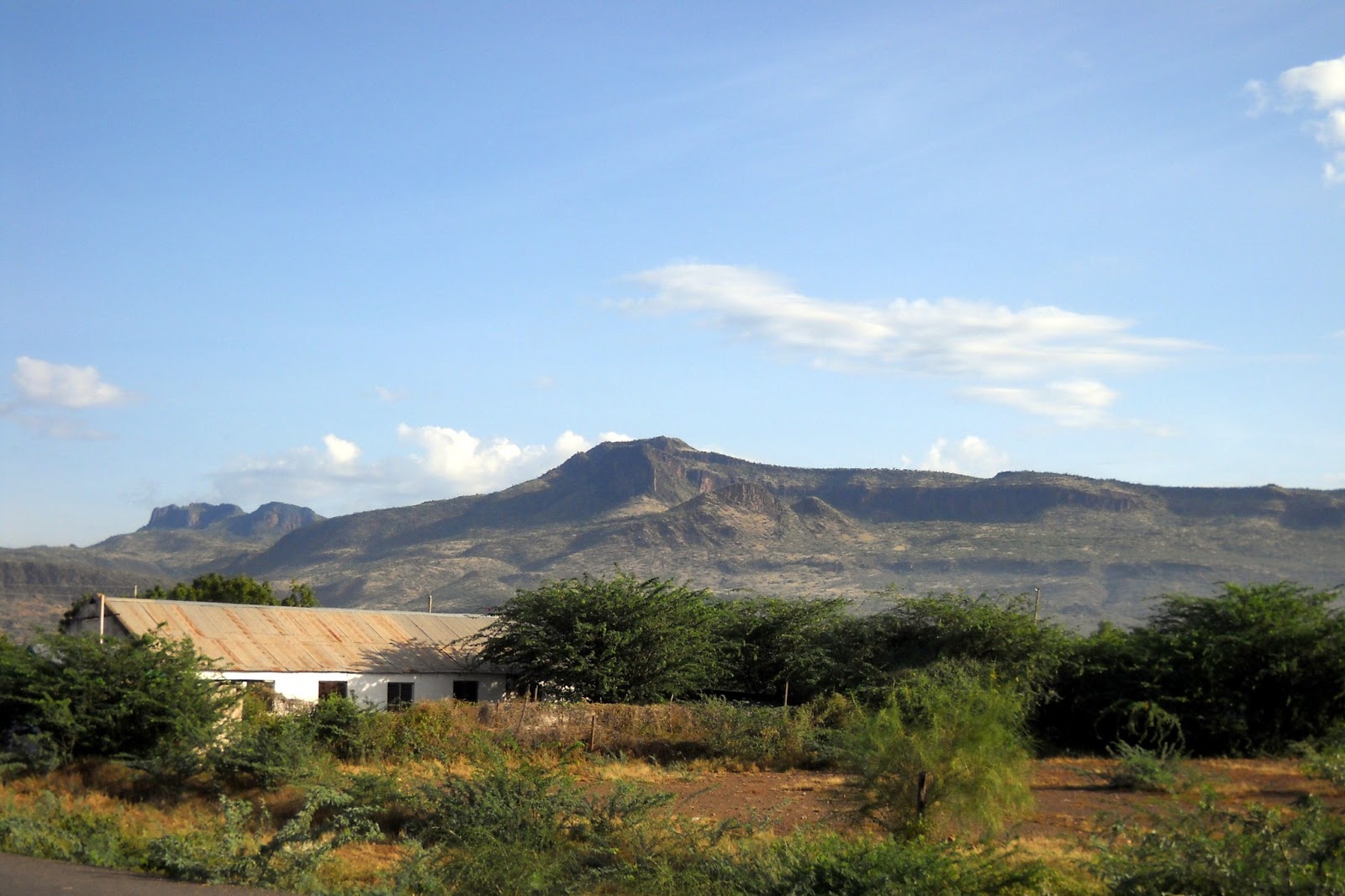 |
| Buildings, like this church, only rarely dot the beautiful landscape. |

Turkana men are almost always seen walking with their goats or cattle, and carrying a walking stick and small stool. Most, like this one, only wear a 'shuka' (blanket) draped over one shoulder.

 |
| Leaving Lokichoggio to head back to Lodwar |


Each herd was accompanied by four to six young men. At least half of them carried an AK-47! Banditry and cattle rustling is an all too common way of life here. [Note: I did not attempt to get a photo of any of them, as I didn't want to upset anyone.]
 |
| I grabbed this shot online, though, to give you an idea. |
 |
| Camels are a common sight |


 |
| Typical Turkana houses |

 |
| Most of these roadside shops were closed. |

 |
| The landscape is dotted with acacia trees and tall termite mounds. |

 |
| Just beautiful! |
 |
| The so-called 'highway' we traveled on. I think it had seen better days! |
 |
| Whiling away the day - under a fan - waiting for our 10pm bus back to Kitale. |

Our first trip was in December of 2006. If you're interested, you can see more photos of the Turkana people in these posts from that trip:
The beginning of our adventure
More shots along the way
Luggas
On our way to see Lake Turkana
Near the lake
Lake Turkana
The Turkana people
More on the Turkana
Professional photos of Turkana
More photos from our adventure
Kakuma town
Items of interest at Kakuma town
More from Kakuma town and vicinity
Kakuma refugee camp
More at the refugee camp
Food distribution at the refugee camp
We went again in August of 2007. Out of that trip came a pretty remarkable story of our search for a friend. You can read it in these posts:
Finding our friend, Part 1: Mark Deng Deng Mayar
Finding our friend, Part 2: Two journeys to Turkanaland
Finding our friend, Part 3: Looking for Deng Deng
Finding our friend, Part 4: Finding Mark Deng Deng Mayar
Finding our friend, Part 5: Another day with Mark
Finding our friend, Part 6: Conclusion
Who knows... we may just go again some fine day. The place is SO fascinating!




.jpg)


+and+nominated+Senator+Zipporah+Kittony+do+a+jig+at+a+dinner+for+members+of+the+new+House+at+the+Intercontinental+hotel,+Nairobi,+following+their+swearing-in+on+Thursday.jpg)

